Address

2301 Av. D'Estimauville,
Québec, Qc G1E 1T2

Email

laboratoireparole@crulrg.ulaval.ca

Call Us

418-821-1229

Attentional control and its neurobiological organisation

Facebook
X
LinkedIn

Imagine the following scene (Figure 1). You’re at a friend’s party in your backyard, chatting with a friend (1). You’re focusing on that person to avoid being distracted by other conversations, while keeping an eye on your dog. Suddenly, you hear a clap of thunder in the distance (2). This distraction caused you to lose sight of your dog (3). You find him hiding in the bushes (4).

This brief scenario illustrates various aspects of attentional control, that is, the ability to select and inhibit stimuli in our environment. In the scenario, your attention was focused on the person you were talking to, but it was also divided between them and your dog, while you were inhibiting other conversations. When the thunder rumbled, your attention was disrupted, causing you to lose sight of your dog. Attention control is ubiquitous in all our daily tasks, from the simplest to the most complex. Attention control is the combination of two skills: attention and inhibition. In this post, we’ll first define these two skills from a behavioral perspective, then discuss their neural basis.

Attention

There are two types of attentional processes: top-down and bottom-up attention. The first major type of attentional process is top-down attention. This form of attention is voluntary—it’s the kind we engage when we choose to focus on something. Listening carefully to the person you’re talking to, watching for cars at an intersection, or keeping an eye on the sidewalk so you don’t walk into a sign: these are examples of top-down attention. This is what we call goal-directed attention. Depending on whether it focuses on a single task or is divided among several, and whether it lasts for a short or long period, it takes different forms: selective, sustained, alternating, and divided attention.

  1. Selective attention is the ability to select a stimulus and focus on that stimulus within one’s environment, while filtering out irrelevant or distracting elements.
  2. Sustained attention is the ability to maintain focus on a task for a long period of time, even when the task is monotonous or repetitive. This type of attention is defined, among other things, by the concepts of focus, stamina, and consistency.
  3. Alternating attention is the ability to shift one’s focus from one goal to another. For example, cooking while following a recipe requires alternating attention. Each task is performed one after the other: reading the recipe, adding an ingredient, reading the recipe, adding another ingredient, and so on.
  4. Divided attention is the ability to process multiple stimuli or perform multiple tasks simultaneously. Unlike alternating attention, multiple goals are pursued at the same time—for example, driving while talking with a passenger. In everyday language, this is called “multitasking.”


Focus

Stamina

Consistency

The ability to remain focused despite occasional distractions (e.g., a dog barking, a notification).
The ability to maintain concentration for a long time, even when the task becomes monotonous.
The ability to maintain a steady level of concentration, without ups and downs, from start to finish. (A combination of focus and stamina).

Let’s apply these concepts to the situation described at the beginning. Our selective attention is focused on the conversation, and it has been sustained since the conversation began. But our attention is also divided, because we’re keeping an eye on our dog. Thus, the different types of attention are not compartmentalized: they constantly combine and overlap, making it difficult to assess them individually.

In our laboratory, we primarily assess selective and sustained attention in the auditory modality. To do this, we use short tasks—less than 5 minutes—to assess selective attention, and longer tasks—more than 10 minutes—to assess sustained attention. In both cases, the tasks are designed on the same principle: they contain a target stimulus and one or more distractor stimuli. It is precisely these distractors that bring into play the second major type of attentional process: bottom-up attention.

The second major type of attentional process is bottom-up attention; this is an automatic process. When we say we’ve been distracted by something—such as a clap of thunder or a notification on our phone—this is the process at work. The stimuli that trigger bottom-up processes generally have intrinsic salience—that is, they capture our attention independently of our will, memories, or intentions. In the initial scenario, thunder is a good example: you don’t need to find it interesting to react to it. However, other types of stimuli can also trigger ascending attention. Through our memories, a stimulus can acquire salience that isn’t based solely on its own properties. This is referred to as “learned or acquired salience.” Imagine that every morning on your way to work, you pass the same person sitting in front of their house. Over time, your attention is automatically drawn to them each time you pass by—not because the scene is objectively remarkable, but because your memory has made it familiar, and thus salient to you.

In summary, top-down attention is our default mode of operation: it’s what directs our attention toward our goals. But it can be interrupted at any moment by bottom-up attention. To limit these interruptions, control mechanisms kick in and help us stay on track.

INHIBITION

Inhibition can be viewed as the complementary aspect of attentional control: just as attention allows us to select a stimulus based on a goal, inhibition allows us to attenuate, or even block distracting stimuli. According to some authors, inhibition is similar to what is known as self-control: it is not limited to counteracting bottom-up attention, but can also enable us to voluntarily suppress certain stimuli, reactions, or thoughts.

Figure 2. Schematic of attentional control

Attention – inhibition relationship

Attention and inhibition work in close synergy (Figure 2); this collaboration is particularly evident when stimuli conflict, that is, when two possible responses compete for our attention and one must prevail over the other. The Stroop effect is the most classic illustration of this. Described by psychologist John Ridley Stroop in the 1930s (Stroop, 1935), it involves a conflict between a word denoting a color and the color in which that word is printed, for example, the word “blue” written in green ink. In a Stroop test, the participant is asked to name the color of the ink, not to read the word. Try it:

Figure 3. Stroop Stimuli. By Grutness à en.wikipedia — File:Stroop_icon.svg, CC BY-SA 4.0, https://commons.wikimedia.org/w/index.php?curid=77022308

It’s difficult, isn’t it? This test requires you to simultaneously focus on the color of the ink and inhibit the word, even though reading it is an automatic process. For the Stroop effect to be pronounced, the target stimulus (the color of the ink) must be less dominant than the distractor stimulus (the word), which is generally the case, since reading is a well-established reflex. Even today, this test remains one of the classic tools of neuropsychology: it is used to assess inhibitory control and mental flexibility, particularly in the study of cognitive aging or attention disorders.

One question remains, however: How does the brain select one stimulus and suppress another? In other words, how does the brain manage attentional control? There is still no definitive answer to this question, but several hypotheses have been proposed. According to one of them, the brain constructs a rejection template: any distractor that matches this template is automatically inhibited (Arita et al., 2012). According to another theory, the brain increases the intensity of the target stimulus, making it more distinct from distractors and thus easier to select (Geng & Witkowski, 2019). In both cases, an additional capacity comes into play: working memory. This allows us to process information over a short period of time, and it is this capacity that “holds in memory” the rejection template or the target to be amplified until the task is completed.

Brain organization

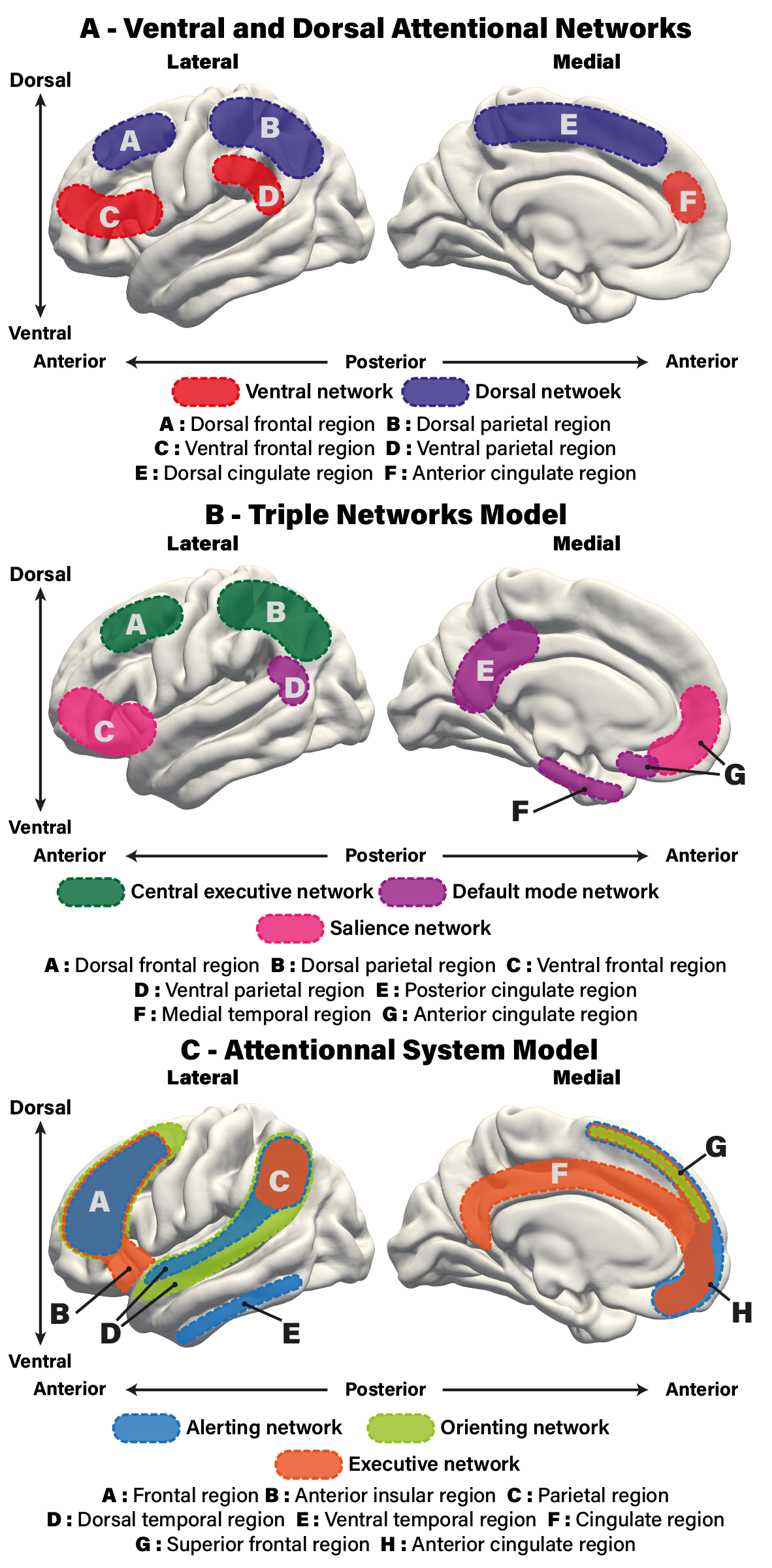
Attention control is supported by a vast neural network. Various theoretical models, ranging in complexity, have been developed to explain the brain’s organization of attentional control. In this section, three models will be presented: the ventral and dorsal attentional networks, the triple-network model, and the attentional system (Figure 4). These are the three most widely used neurological models of attention in the scientific literature.

The Ventral and Dorsal Attentional Networks Model (Corbetta & Shulman, 2002)

This model is closely associated with the concept of bottom-up and top-down attention. According to this model, the ventral network is associated with bottom-up attention, while the dorsal network is associated with top-down attention. Both networks are referred to as fronto-parietal, meaning that the regions involved are located in the frontal and parietal lobes. The ventral pathway involves regions located toward the bottom of the brain (known as “ventral”), while the dorsal pathway involves regions located toward the top of the brain (known as “dorsal”). Several white matter tracts connect the regions within each pathway and facilitate communication between the two pathways. This model is illustrated in Figure 3A.

The Triple-Network Model (Menon, 2011)

Although this model was not specifically designed to study attentional control, it nevertheless allows for its modeling. It is based on three networks: the central executive network, the salience network, and the default mode network. The central executive network closely resembles the dorsal pathway. It consists of dorsal fronto-parietal regions and is thought to be involved in top-down attention—in other words, in our ability to voluntarily direct our focus toward a goal. The salience network, located in the ventral frontal lobe, is thought to be involved in the automatic detection of stimuli, or bottom-up attention. It is thus, in part, analogous to the ventral network. The third network, the default mode network, comes into play when our attention turns inward: wandering thoughts, rumination, daydreaming. It involves several regions spread throughout the brain, notably in the parietal, temporal, and frontal lobes, as well as the posterior cingulate cortex. In short, it is the salience network that detects important stimuli and signals a switch to the central executive network to adjust our attention accordingly. This model is illustrated in Figure 3B.


The Attention System Model (Petersen & Posner, 2012)

The attention system also consists of three networks: the alerting, orienting, and executive networks. Unlike other models, the different networks in this model are less distinct. The networks involve frontal, parietal, temporal, and cingulate regions. The role of the alerting network can be summarized as the ability to maintain a state of vigilance. This is the network that detects a stimulus. The orienting network allows for the prioritization of certain stimuli based on their modality and location. Thus, the alerting network indicates when a stimulus occurs, while the orienting network indicates where it occurs. The executive network is the network that most closely resembles top-down attention. It is believed to be responsible for the voluntary control of attention and is supported by the alerting and orienting networks to detect important stimuli. This model is illustrated in Figure 3C.


Although each model has its own distinctive features, all three incorporate the concepts of top-down and bottom-up attention. In each model, the brain regions involved in voluntary control of attention are located in the dorsal part of the brain, while the regions involved in the automatic detection of salient stimuli are located in the ventral part.

Two important points should be emphasized regarding models of attentional control. First, the vast majority of existing attention tests, such as the Stroop test, are visual—that is, the stimuli are presented visually. The authors of these various models thus drew upon scientific literature focused on the visual modality to develop them. But attention is multimodal: visual, auditory, olfactory, tactile, and more! Nevertheless, a few studies have examined whether these models could be applied to other modalities, such as auditory and tactile. These studies suggest that certain brain regions are activated in the same way, regardless of the stimulus modality. It is therefore possible that the attentional system is amodal that is, it processes all stimuli regardless of their modality.

The second point to note is that these models focus almost exclusively on cortical regions. However, several studies suggest that subcortical structures such as the thalamus, the basal ganglia, and even the cerebellum may also play a role in attention. Attention thus appears to mobilize a much broader network than current models suggest, involving the brain as a whole rather than just the cortex.

Figure 4. Different models of the brain organization of attentional control, illustrated on an average brain

Conclusion

In short, attentional control is an essential ability for nearly all of our daily activities: when it is lacking, many other cognitive functions are affected, as is communication. Attention control is supported by extensive neural networks spread throughout nearly the entire brain. In an upcoming post, we’ll explore how attention control and the brain structures that support it evolve over the course of a lifetime, and how to maintain good attention control as we age.

References cited

Arita, J.T., N.B. Carlisle & G.F. Woodman. 2012. Templates for rejection: configuring attention to ignore taskirrelevant features. J. Exp. Psychol. Hum. Percept. Perform. 38: 580

Geng, J.J. & P. Witkowski. 2019. Template-to-distractor distinctiveness regulates visual search efficiency. Curr. Opin. Psychol. 29: 119–125.

Stroop, J. R. (1935). Studies of interference in serial verbal reactions. Journal of Experimental Psychology, 18, 643–662.

Corbetta, M., & Shulman, G. L. (2002). Control of goal-directed and stimulus-driven attention in the brain. Nat Rev Neurosci, 3(3), 201-215. https://doi.org/10.1038/nrn755

Menon, V. (2011). Large-scale brain networks and psychopathology: a unifying triple network model. Trends Cogn Sci, 15(10), 483-506. https://doi.org/10.1016/j.tics.2011.08.003

Petersen SE, Posner MI. The attention system of the human brain: 20 years after. Annu Rev Neurosci. 2012;35:73-89. doi:10.1146/annurev-neuro-062111-150525