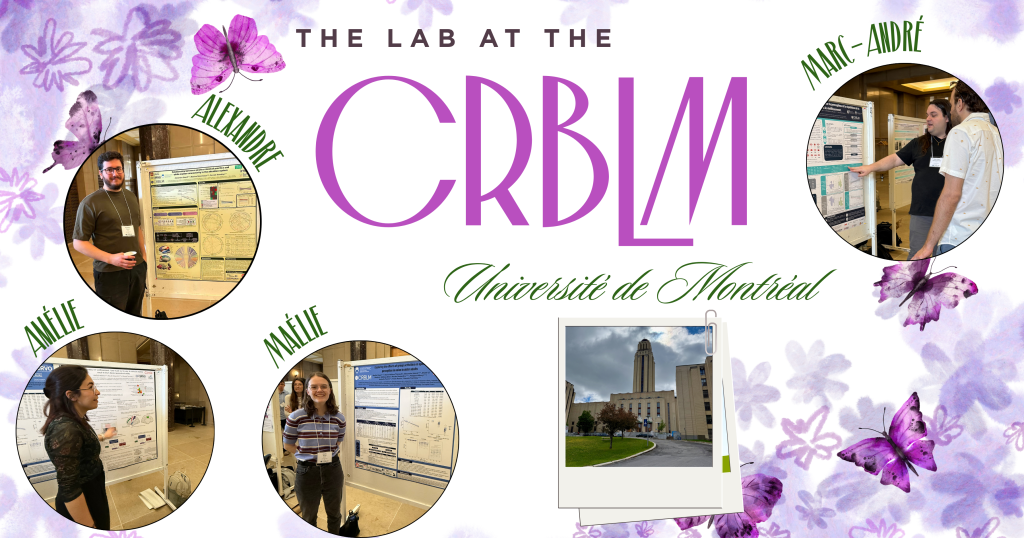
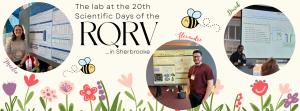
On May 28th, the annual scientific day of the CRBLM — the Centre for Research on Brain, Language and Music — took place at Université de Montréal. Founded in 2002, the CRBLM is an interdisciplinary strategic research group focused on language, music, their intersection, and their neurobiological foundations. The CRBLM brings together 99 regular members from 9 Quebec universities and one college, along with approximately 500 student members. This year’s scientific day featured poster presentations as well as a keynote lecture by researcher Pascal Bélin from the CNRS and Aix-Marseille University, on the neurobiological underpinnings of voice control in humans and primates.
This year, the lab was well represented: four students — Alexandre, Amélie, Maélie, and Marc-André — along with Pascale, the lab director! Each of the four students presented their project findings through scientific posters.
Alexandre’s Poster
Alexandre, a doctoral student in rehabilitation sciences, presented his analyses of white matter within the attention network (Figure 2) — analyses that will form the third publication of his thesis! Alexandre’s research aims to determine whether amateur music practice affects brain organization. He presented his first analyses of structural connectivity, measured using diffusion MRI, within the brain network that controls attention, comparing singers, instrumentalists, and a control group with no musical practice. These analyses were conducted in collaboration with Maxime Descoteaux, a researcher at Université de Sherbrooke and a specialist in white matter. This study is part of our large-scale project, PICCOLO.
Amélie, a Master’s student in rehabilitation sciences, presented the results of her project, which explores the effects of singing on the voice and the brain regions that control the voice (Figure 3). Her project combines acoustic analyses of the voice with structural brain analyses measured by MRI. Amélie’s results show that certain voice characteristics are improved in people who sing, specifically acoustic measures related to voice stability and clarity (shimmer and HNR) and that some of these differences are associated with the structure of brain regions such as the insula and the postcentral sulcus. Amélie also participated the following day in the Journée printanière de la Voix, an annual scientific and clinical event, where she presented her work as an oral communication. Quite the week!
Maélie, a Master’s student in rehabilitation sciences, presented the first results of our longitudinal study MELODIC. The goal of this project is to better understand how certain leisure activities can induce changes in the structure and function of the adult brain, and support healthy aging by sustaining language and cognitive function. As part of the project, we compare the effects of a group musical activity with those of a group non-musical activity, each spanning 15 weeks. For her Master’s, Maélie is investigating the impact of these activities on speech perception in noise and its underlying mechanisms, as measured by MRI. She presented results from the first cohort (38 participants, divided into three groups) — promising findings that pave the way for the next phase of the study (Figure 4)!
Marc-André, a doctoral student in rehabilitation sciences, presented for the first time the results of the first study of his thesis, conducted in collaboration with Edith Durand from the Université du Québec à Trois-Rivières, on the effects of aging on the perception and production of audiovisual speech. The results of Marc-André’s analyses show that adding visual input facilitates speech perception and production in certain circumstances (Figure 5) — a well-documented effect in younger adults. However, when the level of difficulty becomes too high, this effect tends to disappear. A paper is currently being written and is expected to be submitted for publication in June.
A huge congratulations to all four for their hard work, their excellent posters, and their participation in an enriching day of discovery and discussion!