This week, part of our team attended the 20th Annual Scientific Days of the Quebec Network for Research on Aging (RQRV), held in Sherbrooke. The RQRV is a network supported by the Fonds de recherche du Québec (FRQ) that brings together researchers and students from a wide range of disciplines and sectors—including health sciences, natural sciences, and social sciences—to advance innovative aging-related research projects across Quebec. This year, the RQRV is also celebrating its 30th anniversary!
The RQRV Scientific Days brought together many members of the scientific community for this two-day event. The program included a science communication competition, a public panel discussion on caregiving, scientific posters, oral presentations, and numerous networking opportunities.
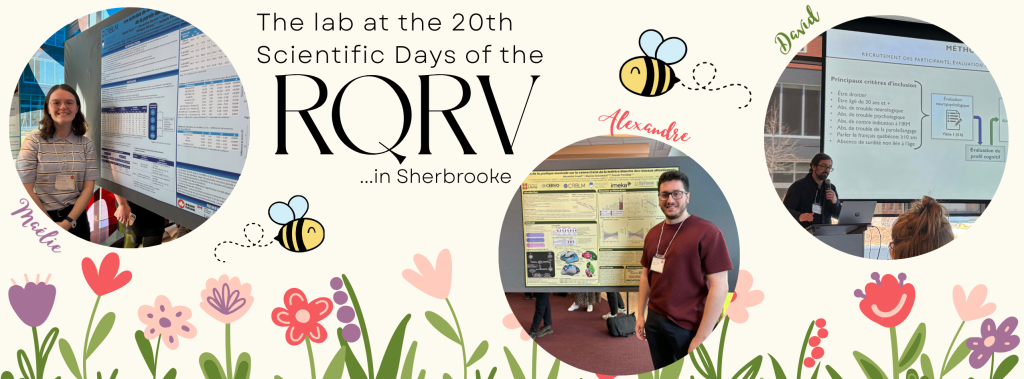
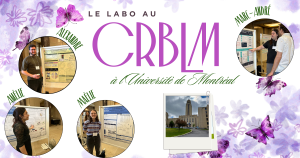
Three students from our lab—Alexandre, Maélie, and David—as well as Pascale, the lab director, participated in this year’s RQRV Scientific Days and presented findings from three major lab projects: PICCOLO, NeuroSPiN, and MELODIC. Alexandre and Maélie presented posters, while David delivered an oral presentation, for which he also received an award.
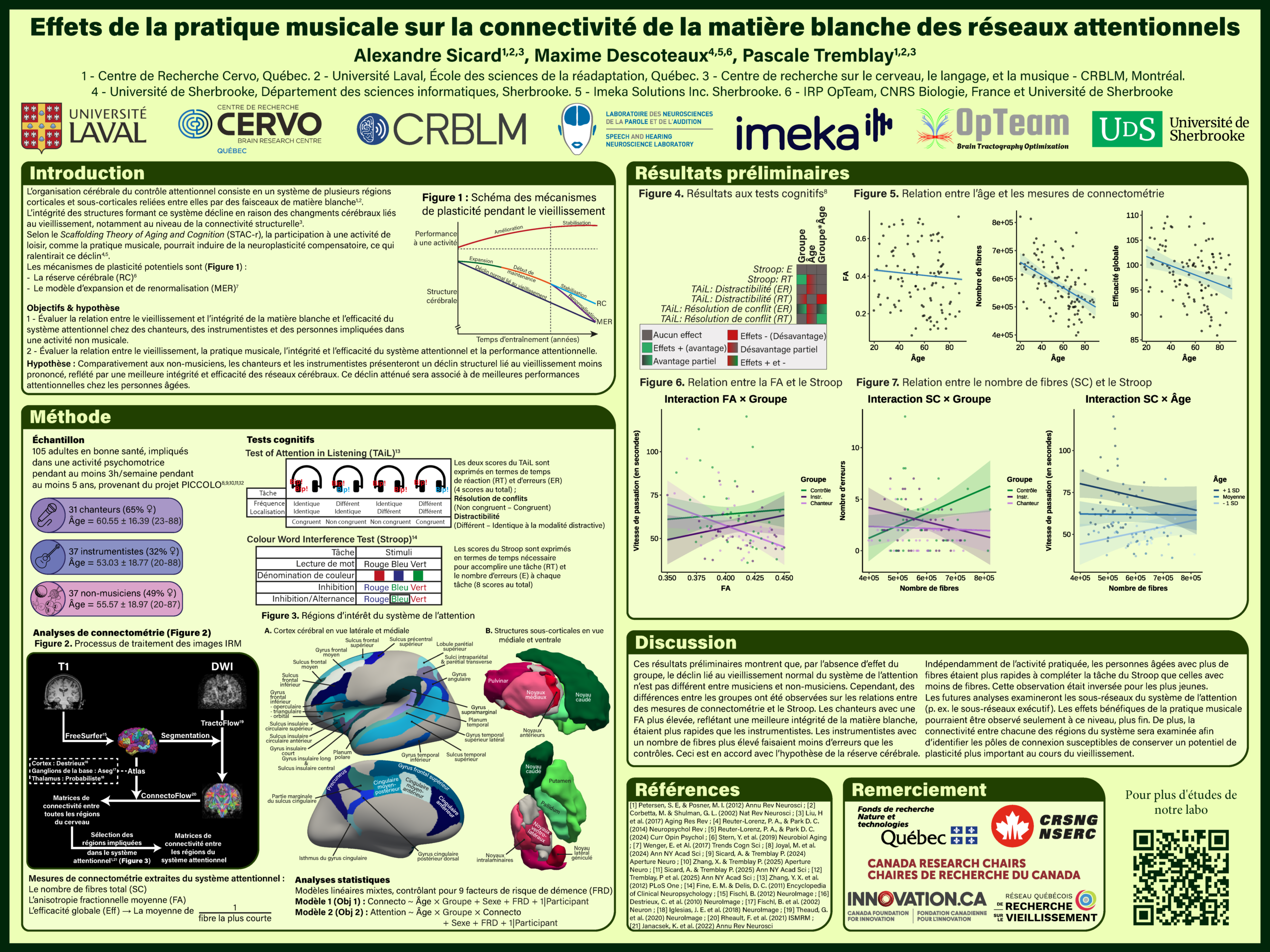
Alexandre’s poster.
Alexandre, a PhD student in Rehabilitation Sciences, presented his most recent analyses from the PICCOLO project, our research initiative on the effects of Practicing an Instrument or Singing on Cognition, Language, and Brain Organization, funded by the Fonds de recherche du Québec – Nature and Technologies (FRQNT) and the Natural Sciences and Engineering Research Council of Canada (NSERC). Musical practice places intensive demands on attention, particularly the ability to focus on a specific sound while ignoring distractions—an ability that tends to decline with age. Alexandre aims to determine whether sustained musical practice leaves lasting traces in brain organization. He has recently begun analyzing structural connectivity, measured using diffusion MRI, within the brain network responsible for attention by comparing singers, instrumentalists, and a control group with no musical training.
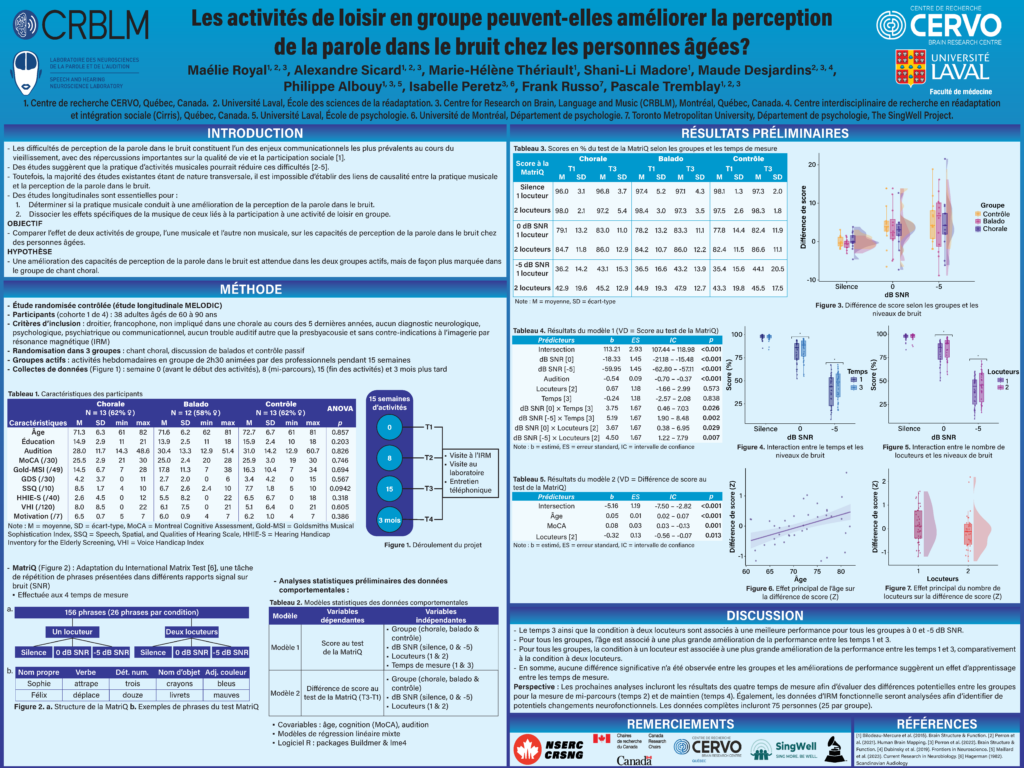
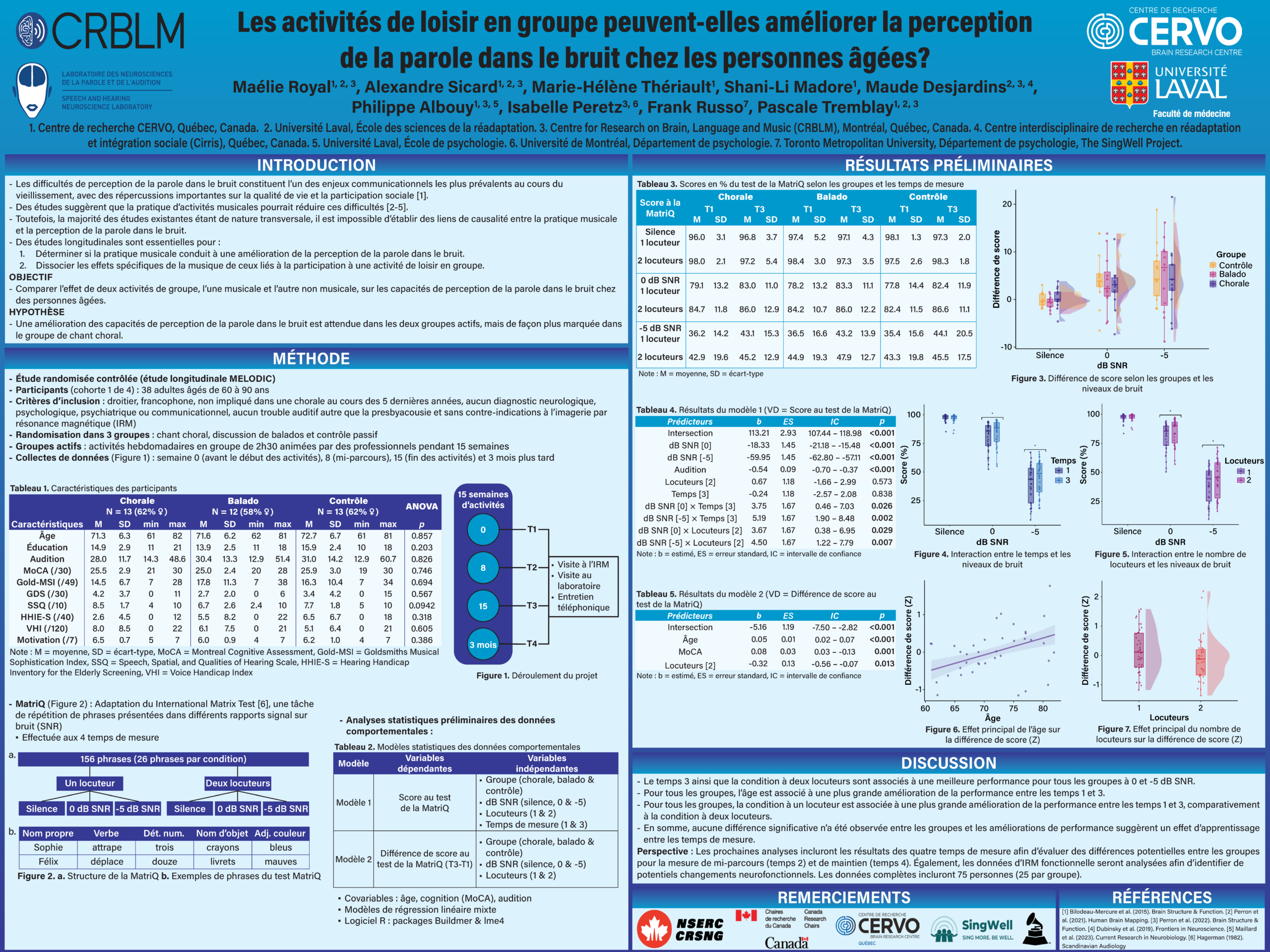
Maélie, a Master’s student in Rehabilitation Sciences, presented the first results from our longitudinal MELODIC study. This large-scale project investigates brain plasticity induced by group leisure activities. Its goal is to better understand how certain activities can lead to changes in the structure and functioning of the adult brain, while promoting healthy aging by supporting communication and cognitive functions and reducing stress. As part of the project, we compare the effects of a 15-week group music activity with those of a 15-week non-musical group activity. A control group allows us to account for learning effects and the passage of time by completing all assessments without participating in any activity. For her Master’s research, Maélie is investigating the impact of group activities on speech perception in noise and its underlying mechanisms, as measured through MRI.
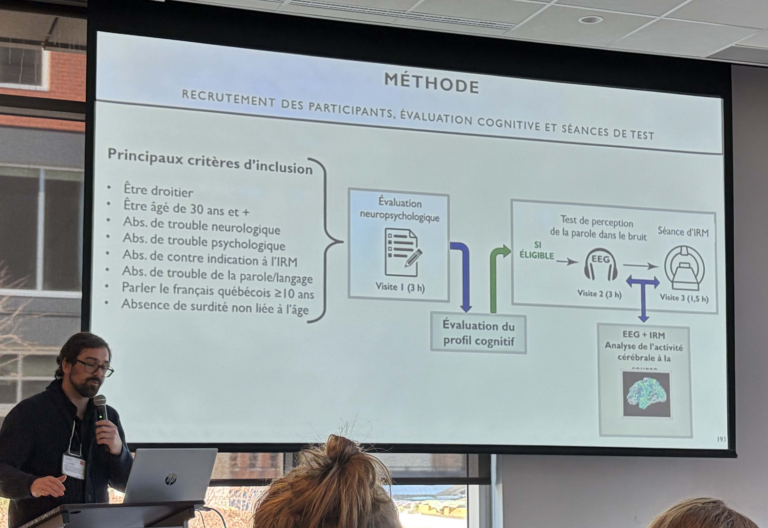
David, an audiologist and PhD student in Rehabilitation Sciences, presented the results of his analyses from the NeuroSPiN project. The goal of this study, funded by the Canadian Institutes of Health Research (CIHR), is to better understand the mechanisms underlying difficulties in speech perception in noise (SPIN), which are highly prevalent among older adults and begin to emerge as early as the late thirties. Because most conversations take place in noisy environments (e.g., in restaurants or at home while the dishwasher is running), these difficulties can have significant consequences, particularly for social participation and overall well-being. As part of his doctoral research, David analyzed brain signals recorded using electroencephalography (EEG) to better understand the neural mechanisms underlying speech-in-noise perception difficulties.
Figure 3. David during his oral presentation
Conclusion
This conference provided an excellent opportunity for the team to share its work, reflect on key issues in aging research, build connections with fellow researchers and students across the network, engage with community partners such as members of the Alzheimer Society, and draw inspiration from the many ongoing projects throughout Quebec. Congratulations once again to David on his well-deserved award, congratulations to Alexandre and Maélie on their excellent presentations, and thank you to the entire RQRV team for organizing such a wonderful event!