The Project
Why NeuroSPiN? The name reflects two central aspects of the study: “Neuro” for the neurological mechanisms being investigated and “SPiN” for Speech Perception in Noise, the focus of the project.
The primary objective of this study is to better understand the neurological mechanisms underlying difficulties in speech perception in noisy environments. Although these difficulties are particularly common among older adults, they can also affect younger adults and are not solely determined by peripheral hearing ability. In other words, even individuals with clinically normal hearing, regardless of age, may experience significant challenges understanding speech in noise, which can interfere with everyday functioning.
Because most daily conversations take place in noisy environments—such as restaurants or at home with background sounds from a dishwasher, the radio, or even a barking dog—the risk of encountering speech perception difficulties in noise is ever-present. These challenges can have important consequences for self-esteem, social participation, well-being, and overall quality of life.
Difficulties understanding speech in noisy environments affect not only healthy older adults, but also individuals with hearing loss or cognitive impairments, further amplifying their impact on daily functioning. For this reason, we recruit participants with a wide range of auditory and cognitive profiles. For example, individuals who wear hearing aids may be eligible to participate, provided that their hearing loss is age-related. Similarly, individuals experiencing memory difficulties or who suspect a decline in their cognitive abilities may also be included in the study.
More specifically, we are seeking 160 participants who meet the following basic criteria:
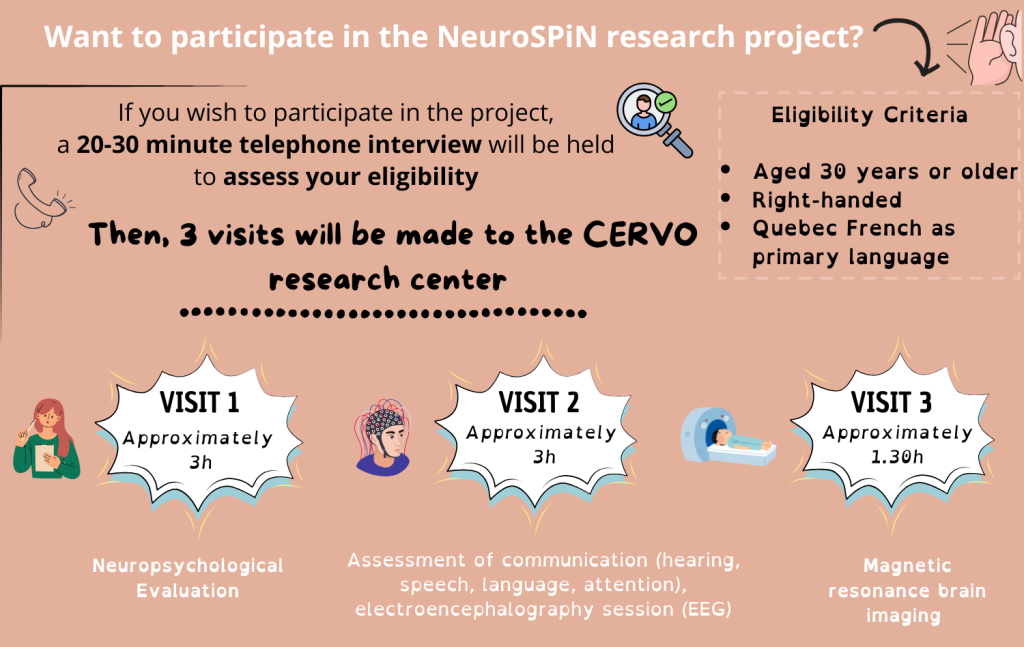
- Be 30 years of age or older;
- Be right-handed;
- Have Quebec French as their primary language.
When an individual expresses interest in participating, a member of the team (David or Évelyne) conducts a telephone interview lasting approximately 20 to 30 minutes to assess eligibility. During this interview, we verify that the individual meets the study’s inclusion criteria and has no contraindications for the magnetic resonance imaging (MRI) session scheduled during the third visit.
Following the telephone interview, the interview form is reviewed by Pascale and often Mélissa to determine eligibility. Based on the selection criteria, participants may be deemed eligible or ineligible. However, this status may be reassessed following the neuropsychological evaluation conducted during the first study visit.
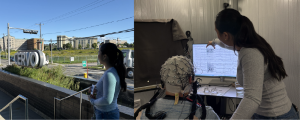
All three visits take place at the CERVO Research Centre and include:
Visit 1: Neuropsychological assessment, including memory and verbal fluency tests, among others (approximately 3 hours).
Visit 2: Communication assessment (hearing, speech perception in quiet and in noise, and selected language functions), an electroencephalography (EEG) session, and an attention test (approximately 3 hours).
Visit 3: Magnetic resonance imaging (MRI) session (approximately 1 hour and 30 minutes).