Address

2301 Av. D'Estimauville,
Québec, Qc G1E 1T2

Email

laboratoireparole@crulrg.ulaval.ca

Call Us

418-821-1229

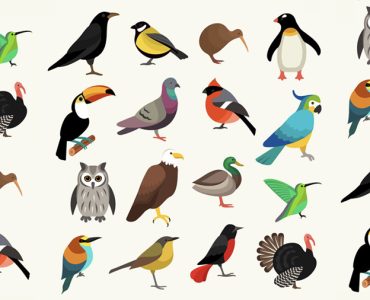
When birds visit the lab! How can birdsong be used in language studies? In a recent project at the lab that included Isabelle Deschamps, Pascale Tremblay, and Melody Courson, we used transcranial magnetic stimulation (TMS) to interfere with the normal functioning of neurons in regions involved in the processing of phonological memory (PM).
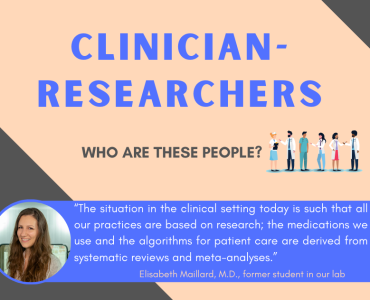
Do you know the expression ‘from bedside to bench and back’? It refers to the influence of clinical practice (that is, the work of healthcare professionals with their patients) on research, and vice versa.
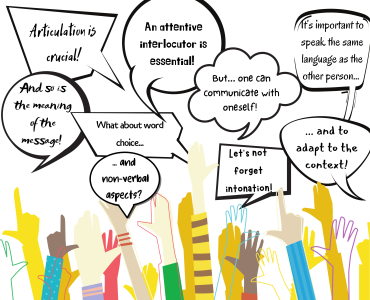
That is the question we asked the members of our laboratory! The diversity of responses we received shows us the complexity of communication and the importance of its multiple facets.
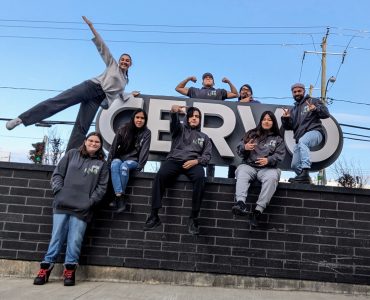
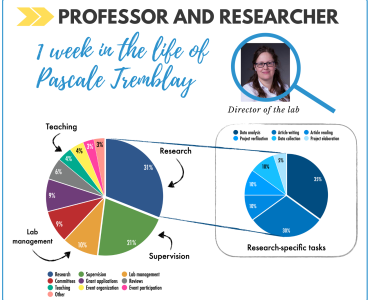
When we arrive in the morning, she is already there. When we leave in the evening, she is still there! Seating at her large desk with headphones and a supply of tea, she only moves to attend meetings, classes, or to the laboratory where her students are working. Who are we talking about? We are, of course, talking about Pascale Tremblay, the director of our lab! She is a full professor at Laval’s Faculty of Medicine – Department of Rehabilitation, and a researcher at the CERVO Research Center.
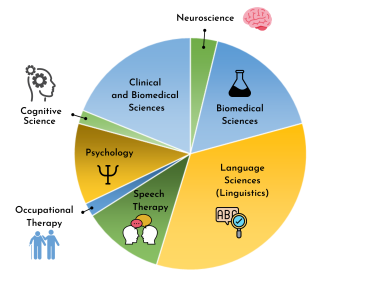
Over the past 10 years, about 100 students have been supervised by the lab director, Pascale Tremblay, in the context of an internship, employment, master’s degree (research or professional), or PhD! While some have pursued a path focused on clinical practice in a master’s in speech-language pathology, many have actively engaged in the research work of the lab. We were curious about the profile of these students, so we checked out their fields of study!
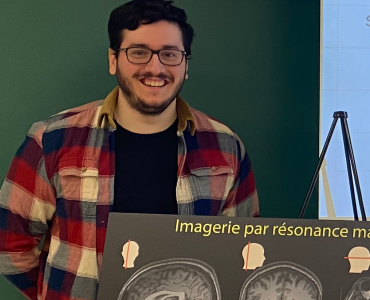
Last November 4th, Alexandre, a master’s student at the lab, participated in the Québec-Chaudière-Appalaches edition of the provincial event Les filles et les sciences (Girls and Science), promoted by La Boîte à science and the organization Les filles et les sciences. The event took place at the Faculty of Science and Engineering at Université Laval.
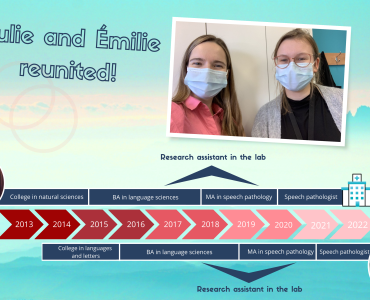
The life paths of some people are sometimes intertwined by chance... This is the case of Julie and Émilie, who were both research assistants in our lab during overlapping periods, and who now find themselves as colleagues in their current professional environment! (This blog post was originally published in French in December 2021.)
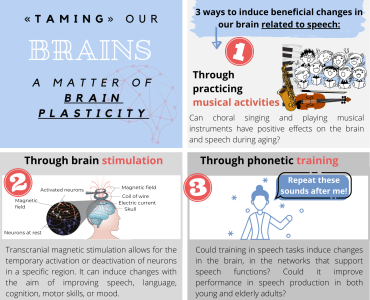
If humans have tamed animals, the elements, and space, can they also tame their own brains? Malleable like plastic and children’s playdough, our brains are capable of adapting and reorganizing themselves throughout our lives. Can we ‘tame’ the mechanisms behind these effects in order to induce beneficial changes in certain areas of the brain?
You have a question and would like to know what researchers have recently written on the topic. Nothing could be more natural. But how do you proceed? Where can you find the information you’re looking for? How do you assess its reliability?
Age-related neurocognitive decline can have a major impact on the life quality. Yet, the adult brain retains the remarkable ability to learn and to transform itself, which can reduce the impact of brain aging. In this post, we discuss our recent paper on the practice of singing, its impact on brain functionning and, in turn, on age-related cognitive decline.