The Cognitive Neuroscience Society (CNS) is a scientific society dedicated to advancing research on the psychological, computational, and neuroscientific foundations of human cognition. Founded in 1994 by six scientists, including Michael Gazzaniga — who also helped coin the term “cognitive neuroscience” in the back of a New York City taxi in the 1970s! — CNS now counts more than 2,000 members worldwide. Its official journal is the Journal of Cognitive Neuroscience, published by MIT Press — a journal Pascale knows well, as she serves as one of its Associate Editors.

Cognitive neuroscience is a relatively young scientific discipline, born officially in the 1970s, well after psychology, biology, or linguistics. Research in this field seeks to understand the brain mechanisms underlying mental functions in healthy individuals (and in patients as well): memory, attention, speech and language, perception, decision-making, motor planning, and many others. By combining tools such as neuroimaging (MRI, EEG), non-invasive brain stimulation, and rigorous experimental methods, research teams work to unravel the complex links between brain activity and human behaviour. Our lab’s work fits squarely within this discipline: understanding how the brain produces and perceives language and its associated mechanisms — such as auditory attention — how these mechanisms change with age, and how we can preserve or enhance them by supporting brain health.
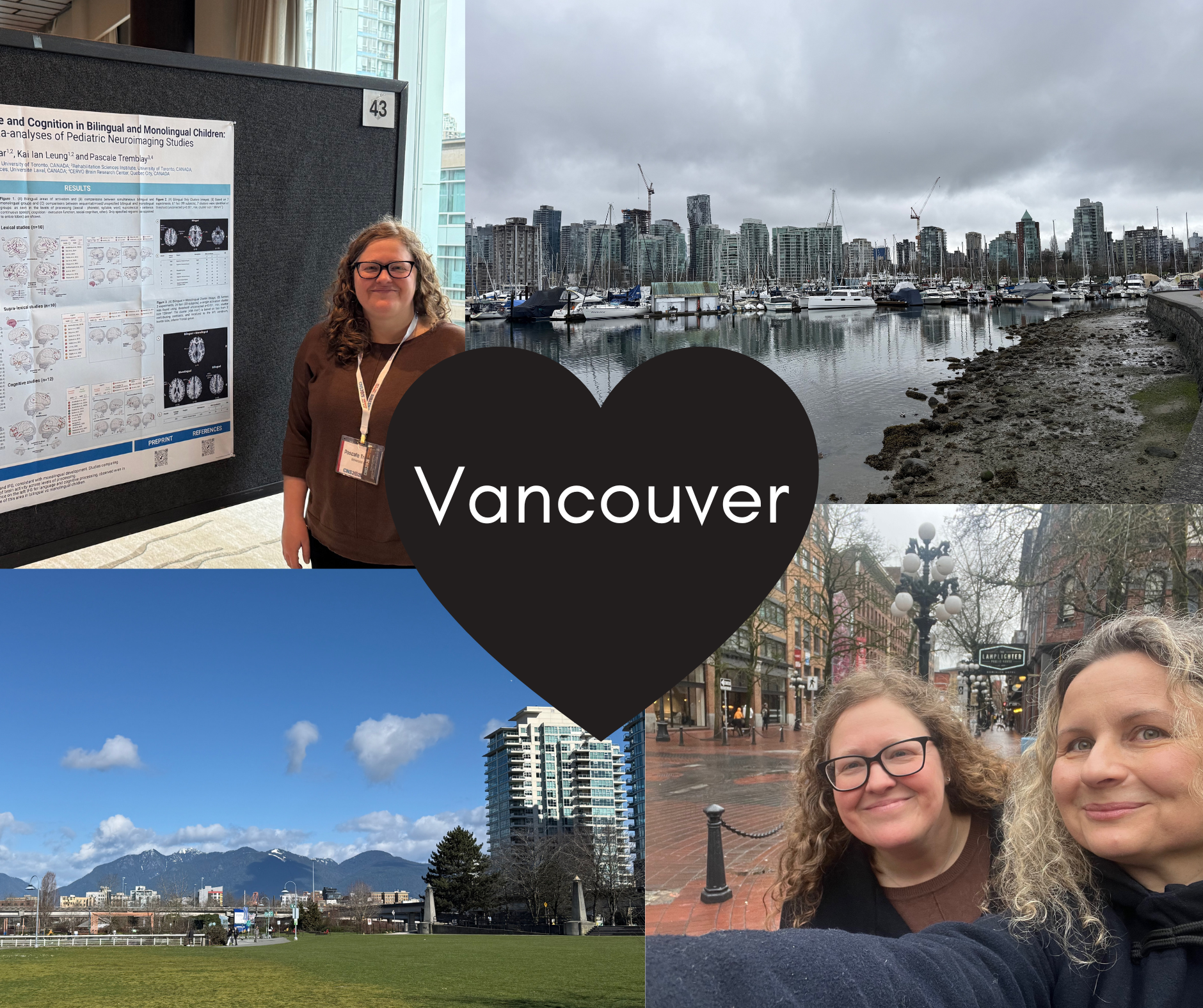
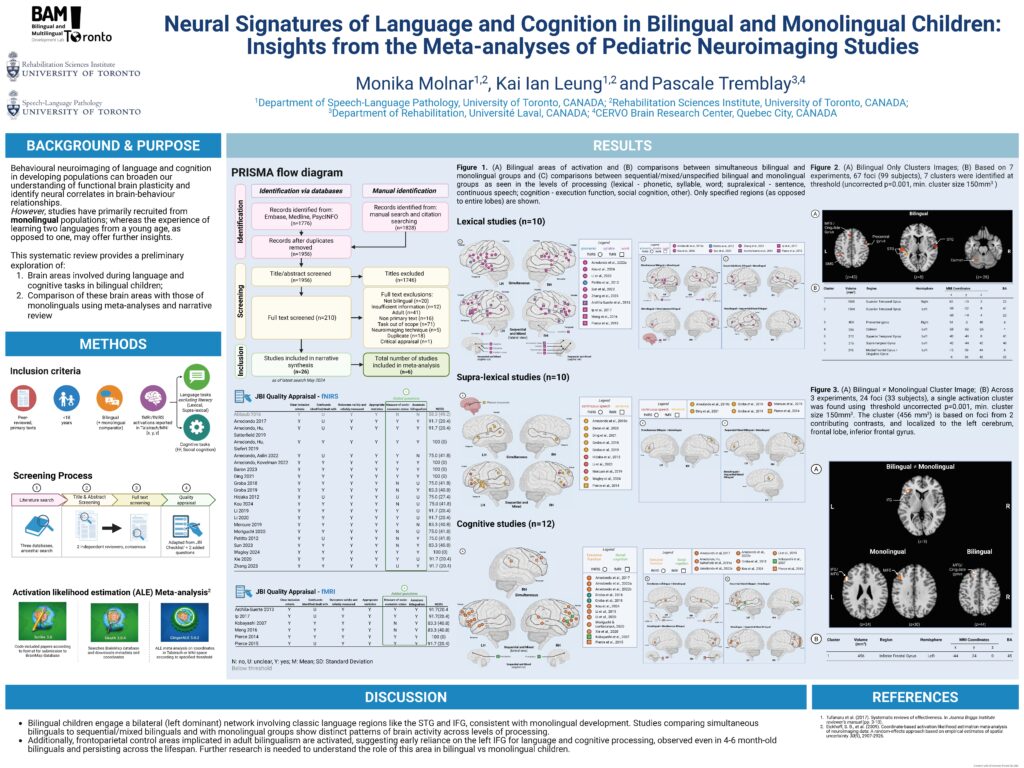
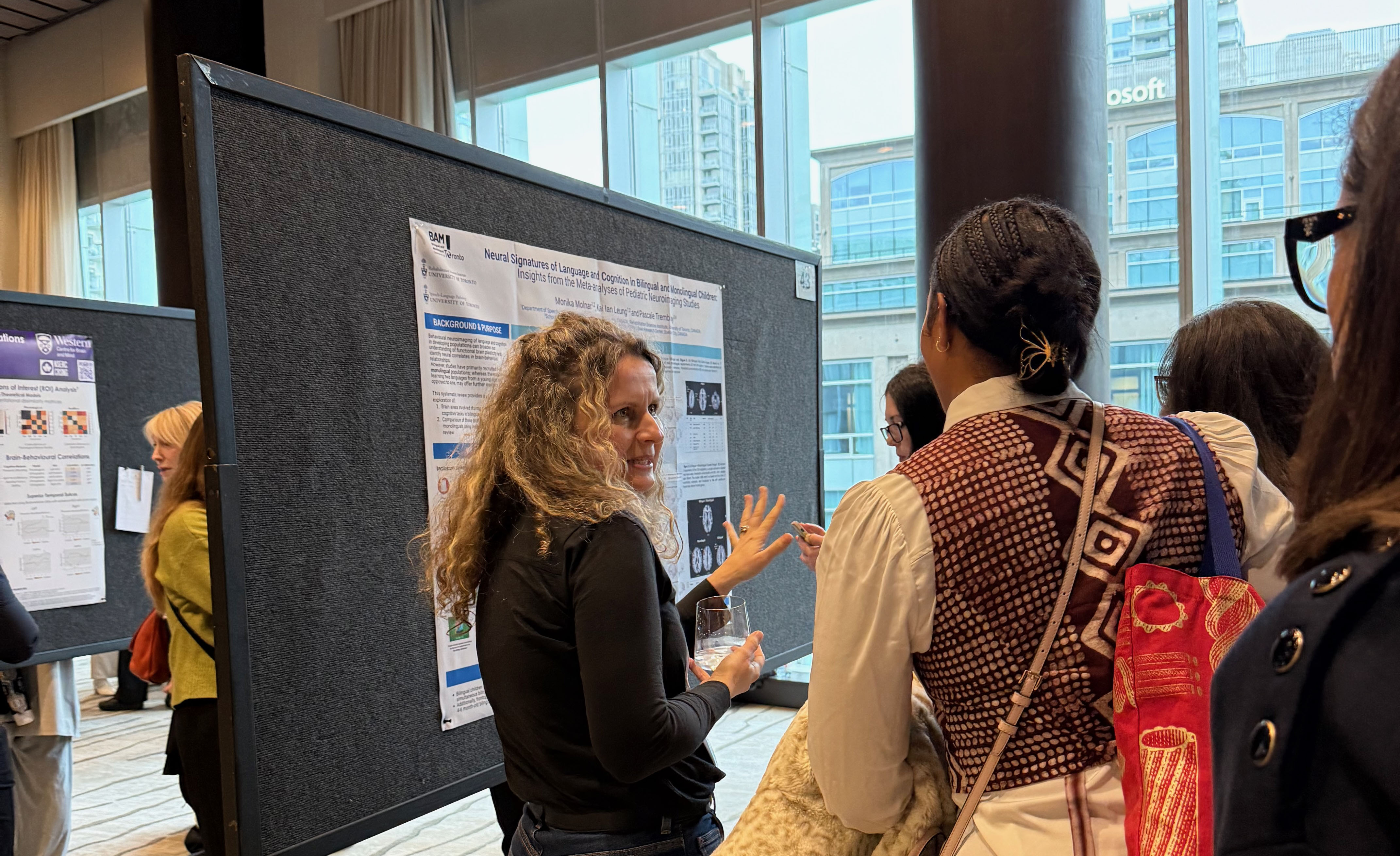
Figure 2. The poster presented at CNS

Each year, the CNS annual meeting brings together researchers from around the world to share the latest advances in the field. This year, the conference was held in Vancouver and drew more than 1,000 participants — students and seasoned researchers alike — for four days of talks, poster sessions, scientific exchanges, and above all, learning and reflection.

Last year, it was Alexandre who represented the lab at CNS. This year, it was Pascale, the lab’s director, who made the trip to British Columbia — and for a very special occasion! She presented alongside her long-time colleague and friend Monika Molnar, a professor at the University of Toronto — with whom she completed her PhD at McGill University — the results of their very first scientific collaboration… after more than twenty years of friendship. Better late than never 🤣.

Their poster, entitled “Neural Signatures of Language and Cognition in Bilingual and Monolingual Children: Insights from Meta-analyses of Pediatric Neuroimaging Studies”, explores the neural bases of language and cognition in bilingual and monolingual children, drawing on a rigorous synthesis of pediatric neuroimaging studies (MRI and fNIRS) conducted by Kai Leung, a doctoral student supervised by Monika. This work has just been accepted for publication in the journal Aperture Neuro!

The full article can be downloaded by clicking here.

Figure 3. Monika presenting the poster at CNS

Beyond the presentations, the conference was an opportunity to connect with colleagues, discover new research directions through the talks, and celebrate the reunion with Maxime Perron, a former lab member recently hired as a professor in audiology at the University of Ottawa, following a PhD and a postdoctoral fellowship in Toronto. Congratulations, Maxime — the whole team is very proud of you! 🎉